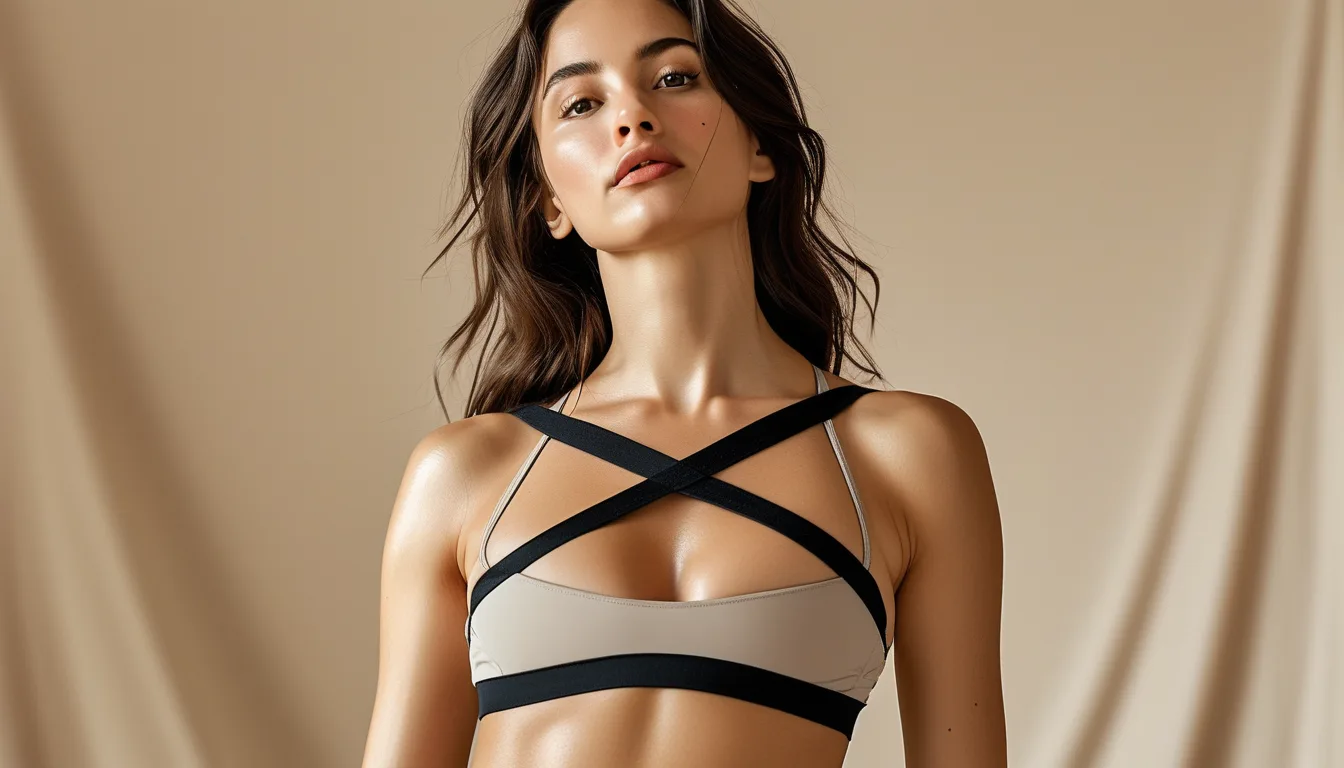
Crossover Waistbands and the Sports Bra Overlap Problem
Quick Answer: Crossover waistbands sit higher on one side than the other by design, so the top edge is not a level line. When a sports bra band ends near that same height, one side overlaps and one side does not, creating an asymmetrical ridge under a fitted top. The fix is vertical separation - either a longer bra that clears the waistband entirely or a shorter one that leaves at least two inches of gap.
If your set looks great alone and slightly off under a tee, this is almost always why.

Why does the crossover create an uneven line?
Because that is the geometry of the design, and it is easy to forget once the piece is on.
A crossover waistband has two overlapping panels that meet at an angle, typically with one side sitting one to two inches higher than the other at the front. That asymmetry is the whole aesthetic - it breaks the horizontal line of a standard waistband and creates a diagonal, which is visually flattering because diagonals suggest movement.
But it means the top edge is not a single height. On one side of your torso the waistband stops at, say, an inch above the navel. On the other it stops at two and a half inches above.
A sports bra band is level. When a level band meets an angled edge, they intersect on one side and not the other. On the overlapping side you get three fabric layers - bra band, upper waistband panel, lower waistband panel. On the other side you get one.
Under a loose top, invisible. Under a fitted top, that difference in thickness shows as a shadow line that appears on one side of your body only, which reads to the eye as an asymmetry in you rather than in the clothes.
How much gap do you actually need?
Roughly two inches of vertical clearance between the bottom of the bra band and the highest point of the waistband.
That number is not arbitrary. Two inches is approximately the distance over which compressive fabric edges stop influencing each other. Closer than that and the two bands push against each other during movement, which is what causes the roll and the ridge. Beyond two inches, they behave independently.
The practical test takes ten seconds. Put the set on, raise your arms overhead, and lower them. If the bra band and waistband touch at any point in that movement, they are too close. Arms overhead lifts the bra band by an inch or so and the waistband by a smaller amount, so it is the worst-case position.
The alternative direction is full overlap - a longline bra or a crop top that extends well past the highest waistband point, ideally by three inches or more. Here the layers are stacked deliberately and evenly rather than meeting at an edge, so there is no ridge, just a smooth double layer.
What does not work is anything in between. A bra ending within about an inch of the waistband top is the specific configuration that produces the problem.

What Nobody Tells You About Which Side Rides Up
It is not random, and it is not your body being uneven.
The crossover panel that sits underneath is the one that migrates. It has less surface friction against your skin because the upper panel is holding it, and its top edge is unsupported. Over the course of a workout it tends to fold or roll downward, which increases the height difference between the two sides rather than evening it out.
This is why the fit problem gets worse during a session rather than better. It is also why it is much more noticeable after you have been sweating - moisture reduces friction between fabric and skin, so the under-panel slides more easily.
There are two things that reduce it. Silicone or grip elastic on the inside of the under-panel - some brands include it, most do not, and you can feel for it in the store. And fabric weight - a heavier, higher-compression fabric holds its edge and rolls less than a lightweight buttery one.
The seasonal angle matters here. In humid late-summer conditions this is at its worst. As the weather cools and you sweat less, the same legging often behaves noticeably better, which fools people into thinking the piece stretched out or recovered. It did neither - the friction conditions changed.
Does the fix change with a longer top?
Yes, and this is the easiest adjustment because it requires buying nothing.
Under a cropped or fitted top, you need the two-inch rule, because the top will follow every contour underneath it.
Under a relaxed tee or oversized layer, the layering rule stops mattering visually but still matters for comfort - the ridge you cannot see can still be the thing digging into your ribs after forty minutes.
Under an open layer like a zip-up or shacket, you are back to the visible rule for the front panel only, since the sides are covered. In practice this means you only need to manage the front intersection, which is usually the easier one.
A styling note for the transition into fall: the moment you start adding a mid-layer, the crossover’s whole visual purpose changes. The diagonal line is the design feature, and covering it with a layer means you are wearing a crossover waistband purely for the fit benefit. That is fine - the fit benefit is real - but if you love how it looks, that is an argument for keeping the crop top a little longer into September and building warmth in the sleeves instead.
FAQ: Crossover Waistband Layering Questions
Can I just wear the bra band inside the waistband?
You can, and for high-impact activity it is actually stable. The downside is that tucking a compressive band under another compressive band creates a genuinely thick layer at the ribs, which many people find restricts breathing depth. If you try it, do it with a lighter-compression bra.
Does sizing up the legging help?
Usually not, and often it makes it worse. A looser crossover waistband has less grip on the under-panel, so it rolls more. The problem is a layering geometry problem, not a size problem.
Why does it only happen with some of my bras?
Band length. Bras of the same nominal size vary by more than an inch in how far down the band sits, depending on style. Measure from the bottom of the band to the waistband edge rather than trusting the label.
TL;DR:
- A crossover waistband is intentionally uneven at the top, so a level bra band overlaps one side and not the other.
- That mismatch creates a one-sided ridge that shows under fitted tops and reads as body asymmetry.
- Aim for two inches of clearance, or full overlap of three inches or more - anything in between is the problem zone.
- The under-panel is the one that rolls, and it rolls more in humid conditions and in lightweight fabrics.
- Sizing up does not fix it; changing bra length or top length does.
Check it with the arms-overhead test before you leave the house, and the whole issue disappears.
See It in Motion
Keep Reading
This article is for general informational and styling purposes only. Fit, sizing, and product availability may vary.