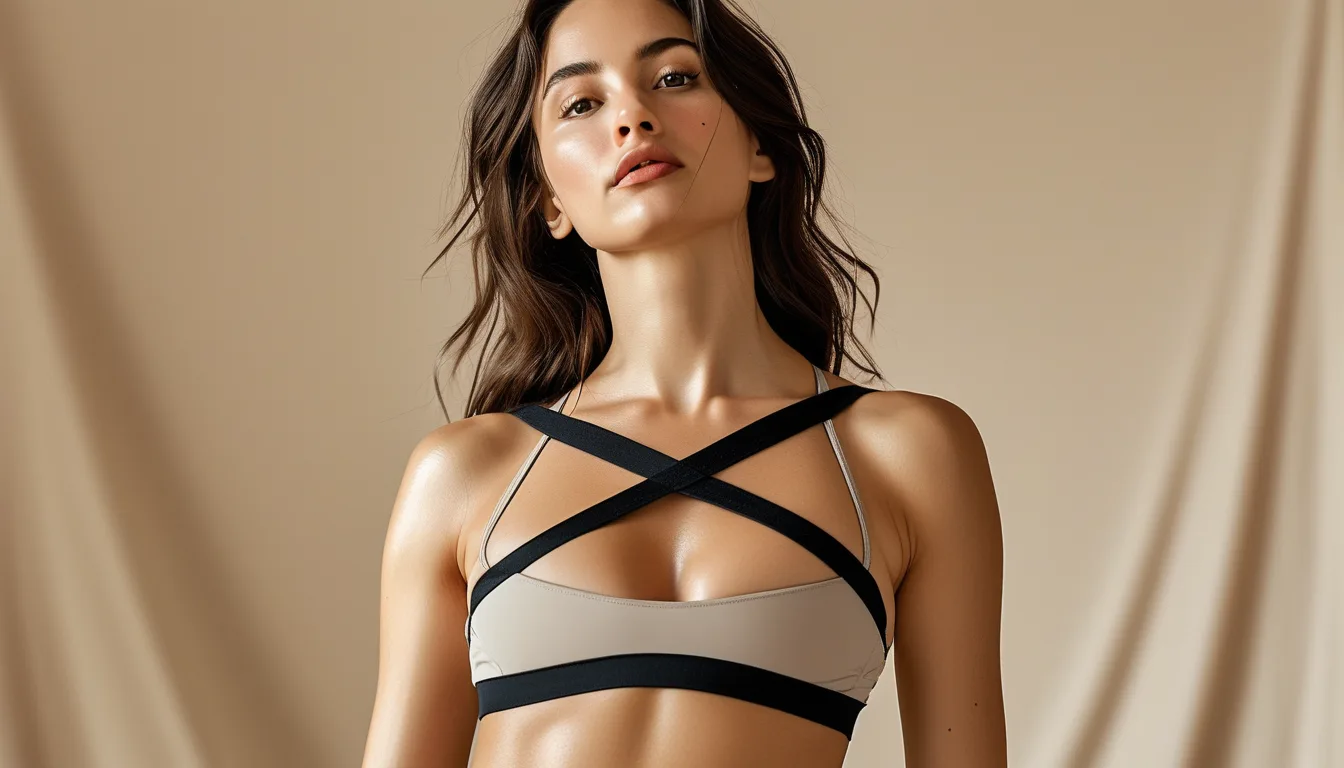
Crossover Waistbands and Torso Length: Why the Same Pair Sits Differently
Quick Answer: A crossover waistband creates a V-shaped dip at the front and a higher rise at the sides. If you have a short torso, that side rise can reach your lower ribs and press when you sit — size for the rise, not the hip, and look for a shallower crossover. If you have a long torso, the same band often sits below your natural waist, which removes the flattering V effect entirely — you want a higher-rise crossover or a deeper cross. Measure from your natural waist to your hip bone: under 7 inches reads short, over 9 inches reads long.

What is a crossover waistband actually doing?
It replaces a straight horizontal band with two overlapping panels that cross at the center front. This does three things at once.
It lowers the center front, creating a V that visually lengthens the torso and avoids the horizontal cut-off line a straight band draws across the stomach.
It raises the sides, because the crossing panels stack where they overlap and rise where they do not. That extra side height is where support comes from — and also where the fit problems start.
It removes the single point of pressure a straight band creates at the front. Instead of one band compressing your midsection uniformly, you get angled tension that spreads across the hip.
The design assumes a specific relationship between where your hip bones are and where your ribs start. When your torso proportions differ from that assumption — which is most people — the V lands somewhere other than intended, and everything else follows.
So the pair is not badly made. It is made for a torso length, and torso length is not on any size chart.
How do you know if you have a short or long torso?
Measure with a soft tape from your natural waist — the narrowest point, usually about an inch above the belly button — down to the top of your hip bone.
Under 7 inches: short torso. Your ribs sit close to your hips. High-rise anything tends to press against the lower ribs, and crossover side panels are more likely to reach an uncomfortable height.
7 to 9 inches: average. Most crossover bands are drafted for this range and will land roughly as designed.
Over 9 inches: long torso. There is more distance to cover, so a standard high rise arrives lower on you than on the model. The V may land near the hip rather than the stomach, which loses most of the lengthening effect.
A faster proxy if you do not have a tape: put your hands flat on your waist, thumbs back, fingers forward. If your fingertips reach your hip bones easily with the heel of your hand at your ribs, you are on the shorter side.
One useful check that skips measuring entirely: sit down in the pair for a full minute. Short-torso pressure shows up when seated, not standing, because sitting compresses the space between ribs and hips further.

What should each torso length look for?
Short torso:
- A shallower crossover — less overlap means less side height.
- Wide, soft side panels rather than a firm double-layer band, which distributes the pressure instead of concentrating it.
- Consider mid-rise crossover styles, which are increasingly available and put the V closer to where it flatters on you.
- Avoid stacked construction where the crossover sits over a separate inner band; that is two layers of compression right at your ribs.
Long torso:
- Extra-high rise versions, often labeled as such. The extra inch or two puts the V back on the stomach where it belongs.
- A deeper cross, which creates a longer diagonal line and reads better across a longer midsection.
- Watch the inseam too — long torsos often go with proportions where standard-length leggings sit fine, so the fix is usually rise-only.
- If a pair sits too low, it will also slide, because there is not enough band above the widest part of the hip to hold it.
Everyone: try the sit test and the deep squat test in the fitting room. Crossover bands reveal their problems in motion, not in the mirror.
What Nobody Tells You About Crossover Bands
The crossover can migrate sideways. Because the panels overlap rather than form a closed ring, a loose pair can twist so the V ends up off-center. That is a sizing signal — the band is not gripping enough.
They are less forgiving of weight fluctuation than straight bands. A straight band stretches uniformly. A crossover changes both its overlap depth and its side height, so a half-size shift changes the look, not just the fit.
The V is a real visual effect, not a marketing claim. A diagonal line draws the eye along its length rather than stopping it, which is why crossovers photograph as lengthening. It works best when the V is actually visible — under a long top, you are paying for a feature you cannot see.
Post-meal comfort differs sharply. Many people find the crossover more comfortable after eating because the front is lower and does not press on the stomach. Others find the higher sides worse. It depends entirely on where you carry pressure.
Fabric weight changes everything. A thick, structured crossover holds its shape and its pressure. A lightweight one relaxes into your body and forgives torso mismatch far better.
FAQ: Crossover Waistband Questions, Answered
Do crossover waistbands roll down like regular high-rise?
Less often, because the diagonal seams resist the folding motion that causes rolling. They can still slide as a whole if undersized at the hip, which looks different — the whole band travels rather than folding over.
Are they good for postpartum wear?
Many people find the lower center front more comfortable across the abdomen than a straight high-rise. If you have had abdominal surgery of any kind, comfort over an incision line is individual — go by how it feels, and check with your provider about compression if you are still healing. This is general information, not medical advice.
Can you wear a crossover under a fitted top?
Yes, and the seam lines are usually less visible than a straight band’s single edge, since the crossover spreads the transition over a diagonal rather than one horizontal ridge.
Should I size up if the sides feel high?
Sizing up lowers the sides slightly, but it also loosens the hip and can cause the band to twist. A shallower crossover in your normal size is the better fix.
TL;DR:
- Crossover bands lower the center front and raise the sides — the side height is what causes most fit complaints.
- Measure natural waist to hip bone: under 7 inches is short-torso, over 9 is long.
- Short torsos want a shallower cross, softer side panels, and sometimes a mid-rise version.
- Long torsos want an extra-high rise and a deeper cross so the V lands on the stomach, not the hip.
- Test by sitting, not standing — that is where the pressure shows up.
The crossover is a proportion feature. Once you know your own proportion, choosing one stops being a gamble.
See It in Motion
Seen here: Super High Waist Embossed Yoga Leggings with Inner Pocket — shop it on bubblelime.com
Keep Reading
This article is for general informational and styling purposes only. Fit, sizing, and product availability may vary.