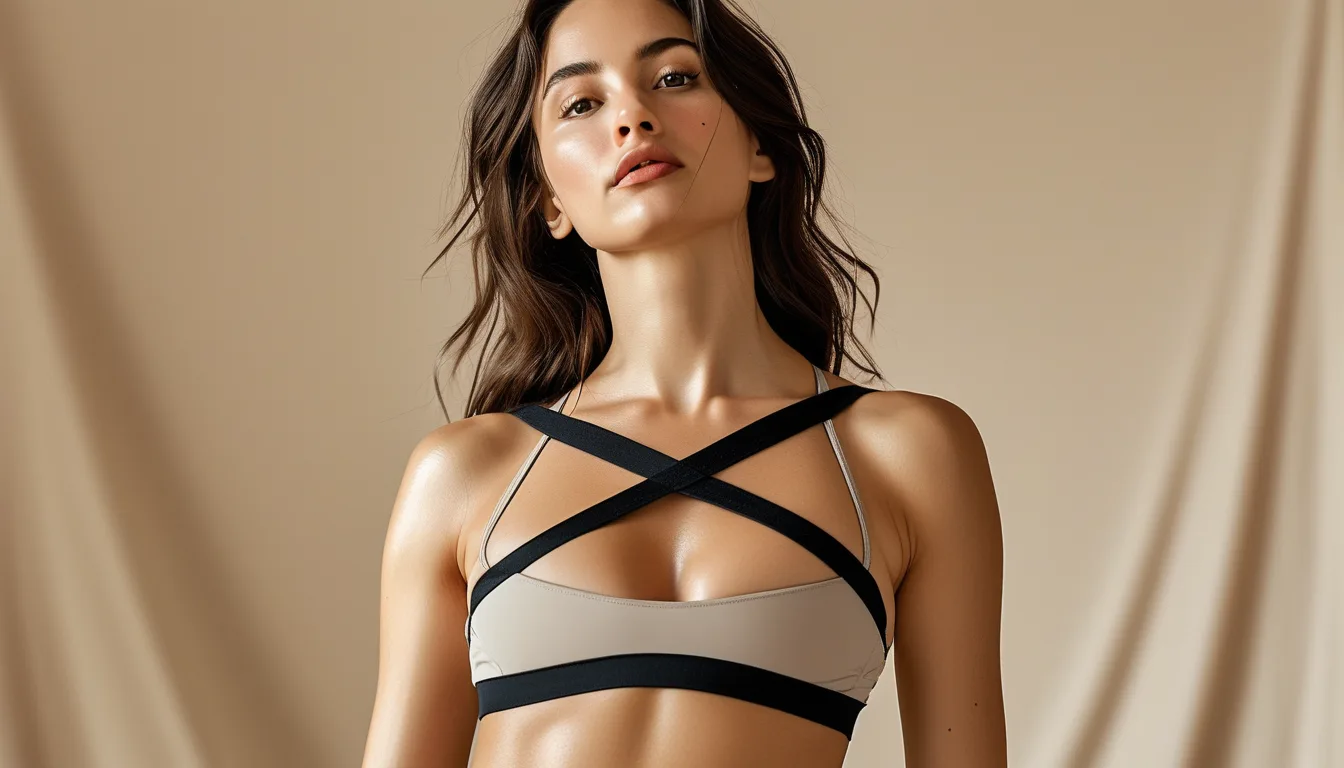
The Crossover Waistband Tests Nobody Does Before Buying
Quick Answer: The fitting room test for a crossover waistband - standing still, looking in a mirror - misses the three situations where it actually fails: sitting for a long stretch, a full stomach, and deep forward bending. A crossover band that passes those three is one you will keep wearing. Test by sitting for at least ten minutes, doing a full forward fold, and being honest about whether the diagonal seam is pressing rather than resting.
The crossover waistband looks flattering standing up in good light. That is the easiest test it will ever face.
The real ones happen in a chair after lunch.

Why does a crossover waistband behave differently from a straight one?
The geometry changes where pressure lands.
A standard high-rise band applies pressure in a horizontal ring. A crossover band applies it along a diagonal, with one panel overlapping the other. That produces two distinct zones: a doubled-fabric section where the panels overlap, and a single-layer section elsewhere.
The doubled section is stiffer. More layers means less stretch in that area. Where that stiffer section sits relative to your torso determines almost everything about comfort - and it moves depending on your torso length and where you actually wear the waistband.
The V-point matters most. The lowest point of the crossover sits over the lower abdomen, and because the fabric converges there, it concentrates pressure at a single spot rather than distributing it.
This is why crossover bands are polarising. For someone whose proportions place that convergence comfortably, it is the most comfortable waistband style available - it avoids the horizontal dig of a standard band entirely. For someone else, the same design puts a stiff point exactly where the stomach expands after eating.
The practical consequence: you cannot tell from a review whether a crossover band will work for you, because the reviewer’s torso is not yours. You can only tell by testing it in the situations where it would fail.
What are the three tests worth doing?
All three take under fifteen minutes, and all three can be done before removing tags.
Test 1: Sit for ten minutes. Not thirty seconds - ten minutes, in a normal chair, doing something. Sitting compresses the abdomen and shifts the waistband upward. A band that is comfortable standing can dig within five minutes of sitting, and the fitting room never reveals it.
What to notice: whether the V-point is pressing into you, whether you have adjusted the band without thinking about it, and whether there is a mark when you stand up. An unconscious adjustment is the strongest signal - your hands know before you do.
Test 2: Bend fully forward. A full forward fold or a deep squat. This is where the crossover either stays put or rolls. The doubled panel section can fold over on itself, which creates a hard ridge.
What to notice: whether the overlap stays flat, and whether you have to reset it when you stand up. A band you reset after every squat will annoy you within a week.
Test 3: The full stomach test. The one nobody does, and the one that matters most. Abdominal circumference changes measurably through the day and across a cycle, and a crossover band that fits at 9am can be uncomfortable at 8pm.
How to approximate it without eating a meal in a fitting room: take a full breath into your stomach and hold it. If the V-point goes from resting to pressing, you have your answer.
A useful fourth check if you can: walk up a flight of stairs. Movement plus a raised knee shows whether the overlap shifts in a way that standing still hides.

What causes a crossover band to slide down?
Three things, and they are diagnosable.
Insufficient tension at the top edge. A crossover band relies on the upper edge to stay anchored, and if that edge is looser than the body of the band, the whole thing migrates. This is a design issue rather than a sizing one - some brands finish the top edge with a stronger elastic, and those hold.
Sizing up to solve a different problem. People who find the V-point pressing often size up, which relieves that pressure and introduces sliding. The correct fix is usually a different rise or a different brand’s geometry, not a larger size.
Torso length mismatch. A crossover band designed for an average torso sits too high on a short torso and too low on a long one. On a short torso the band reaches the ribs and pushes down as you breathe. On a long torso it sits below the natural waist, where there is less shape to hold it.
How to tell which one you have:
- Slides straight down evenly - top edge tension, or sized too large
- Rolls at the top edge - band sitting on the ribs, torso too short for the rise
- Slides at the front only - the V-point is being pushed down by abdominal shape
- Twists as it slides - panel construction issue, generally not fixable
The seasonal note: in humid late summer, skin and fabric both get slightly slick, which reduces the friction the band relies on. A band that is borderline in dry conditions slides in humidity - worth knowing before blaming the garment permanently.
5 Mistakes People Make With Crossover Waistbands
1. Judging it standing still in a mirror. The style is designed to look good in exactly that position. Every real test is a movement or a duration test.
2. Sizing up to relieve V-point pressure. This creates a sliding problem in place of a pressure problem. If the V-point presses, the geometry does not suit your torso and a larger size will not correct it.
3. Wearing it at the wrong height. Crossover bands have a much narrower correct-position range than straight bands. Pulled too high, the top edge rolls; too low, the V-point sits over the softest part of the abdomen. Finding the correct height and consistently wearing it there solves a surprising share of complaints.
4. Assuming all crossover bands are the same. The depth of the V, the width of the overlap, and the top edge finish vary enormously between brands. Disliking one crossover legging tells you very little about the next.
5. Ignoring how it behaves after a wash cycle. The overlap section, being doubled, can distort in a hot wash or a tumble dryer in ways a single-layer band does not. Cold wash and air dry keeps the geometry intact - and if a band goes strange after three washes, that is a construction issue worth returning.
FAQ: Crossover Waistband Questions, Answered
Is a crossover band better for bloating than a straight one?
For some people, considerably - it avoids the horizontal ring of pressure entirely. For others it is worse, because the V-point concentrates pressure at a single spot over the lower abdomen. It depends on where that point falls on your torso, which is why the held-breath test is worth doing.
Why does mine roll down at the top edge?
Usually because the rise is too long for your torso and the top edge is sitting on the ribcage, where breathing pushes it down repeatedly. A lower rise in the same style often fixes it entirely.
Do crossover waistbands work under fitted tops?
The overlap creates a slight ridge that shows under very thin, close-fitting fabrics. Under anything with structure or a skimming fit, it is invisible. If you mainly wear thin fitted tops, a seamless straight band is a safer choice.
Should I size down for more hold?
Rarely a good idea. Sizing down increases V-point pressure faster than it increases hold, because that is the least stretchy part of the band. Look for a style with a firmer top edge instead.
Does the overlap wear out faster?
The doubled section takes more friction, particularly against seatbelts and chair edges. Washing inside out in cold water and air drying meaningfully extends how long the overlap keeps its shape.
TL;DR:
- The standing mirror test is the easiest test a crossover band will ever face, and it predicts almost nothing
- Sit for ten minutes, bend fully forward, and take a full breath into your stomach - those three reveal the real fit
- Sizing up to fix V-point pressure trades a pressure problem for a sliding problem
- Sliding straight down means top-edge tension; rolling at the top means the rise is too long for your torso
- Crossover geometry varies enormously between brands - one bad experience tells you very little
- Cold wash and air dry, because the doubled overlap distorts in heat
The fitting room shows you the one position where it always works. Test the other three.
See It in Motion
Seen here: High Waist Yoga Leggings with Side Pockets — shop it on bubblelime.com
Keep Reading
This article is for general informational and styling purposes only. Fit, sizing, and product availability may vary.